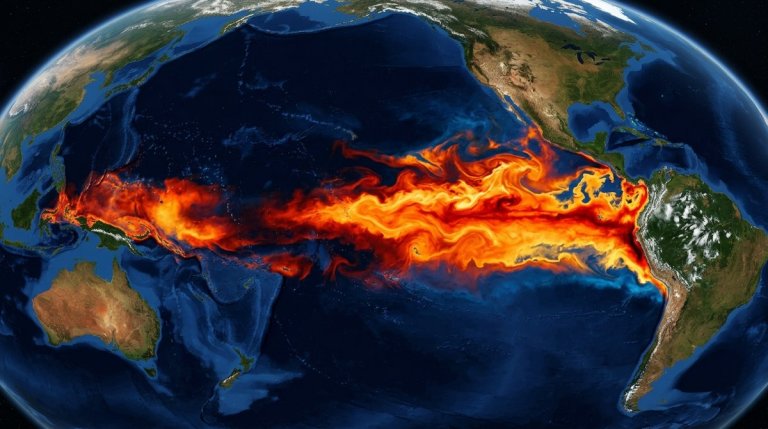

El Niño-powered drought leaves Indonesian palm farmers high and dry as river recedes
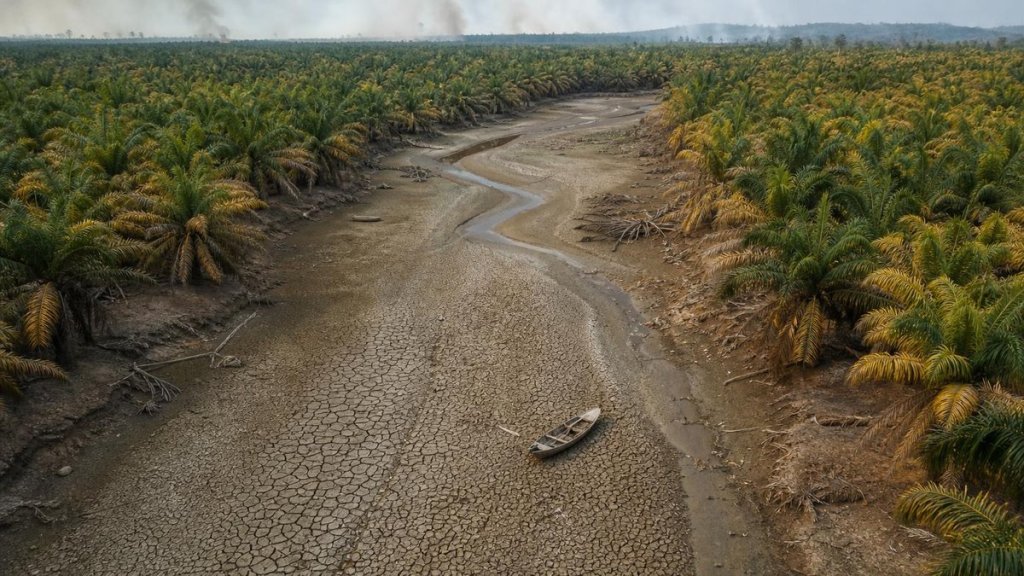
The Kapuas River in West Kalimantan used to flow wide and brown past Suparman’s two-hectare palm oil plot. Now it’s a cracked spine of mud, and his diesel pump sits silent. The fuel costs more than the water would earn him, and anyway, the river’s dropped so far the suction hose can’t reach what’s left.
Suparman, who like many Indonesians goes by one name, isn’t alone. Across Borneo and Sumatra, smallholder palm farmers are watching 2024’s El Niño drought hollow out their livelihoods. The same warming pattern that dumps rain on California and dries out Southeast Asia has turned Indonesia’s normally wet tropics into a tinderbox, and the country’s palm oil sector, which feeds everything from chocolate to biodiesel, is taking the hit.
What El Niño Actually Does to Indonesian Rainfall
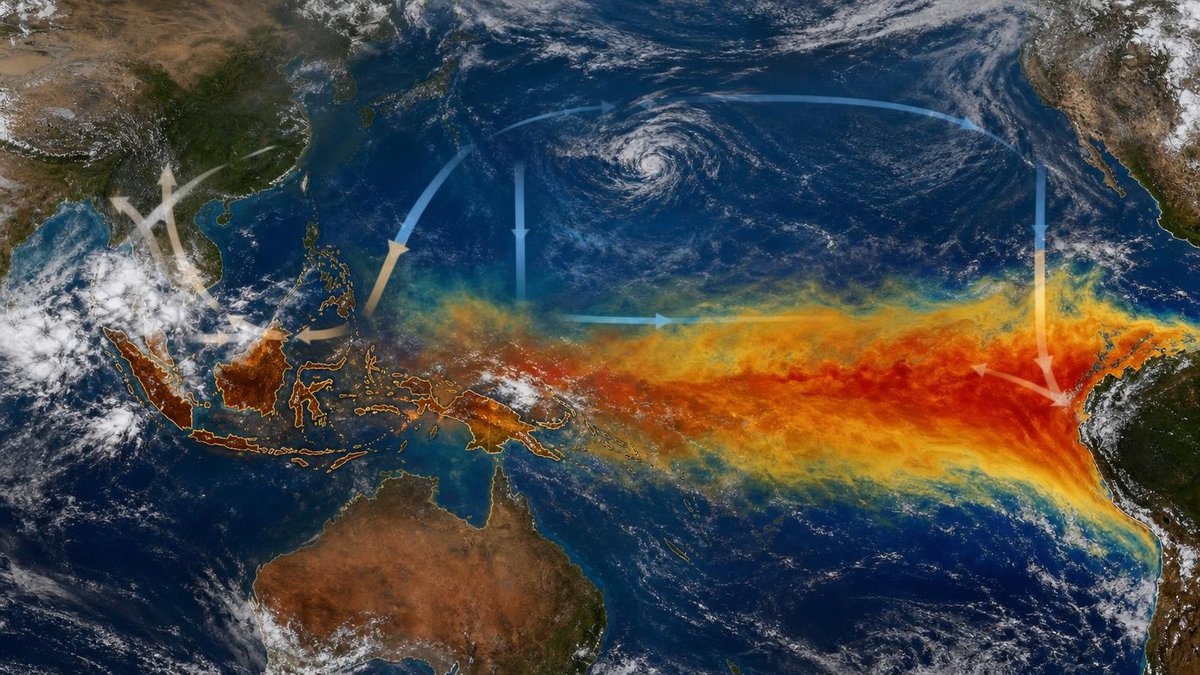
El Niño isn’t just “warm weather.” It’s a shift in the Pacific Ocean’s temperature gradient that rearranges atmospheric circulation across the tropics. During strong events, Indonesia’s wet season shrinks or fails entirely. The country’s Meteorology, Climatology and Geophysics Agency (BMKG) confirmed that the 2023-2024 El Niño ranked among the most intense since 1997, with sea-surface temperature anomalies in the Niño 3.4 region peaking around 2.0°C above the long-term average.
That warmth translates directly to moisture deficits on the ground. BMKG data show rainfall in parts of Central and West Kalimantan falling 60% below normal during the October 2023 to March 2024 wet season, the period when palm trees need steady water to maintain fruit bunch development. The drought didn’t just reduce rain; it concentrated what little fell into brief, damaging bursts that ran off cracked soil rather than soaking in.
The Intergovernmental Panel on Climate Change has warned that climate change is amplifying El Niño’s impacts, making extreme events more frequent and their dry-phase consequences more severe across maritime Southeast Asia. For palm, a crop that demands 1,500 to 2,500 millimeters of evenly distributed rainfall annually, this is a structural problem dressed up as a weather event.
The River Recedes, and Everything Follows
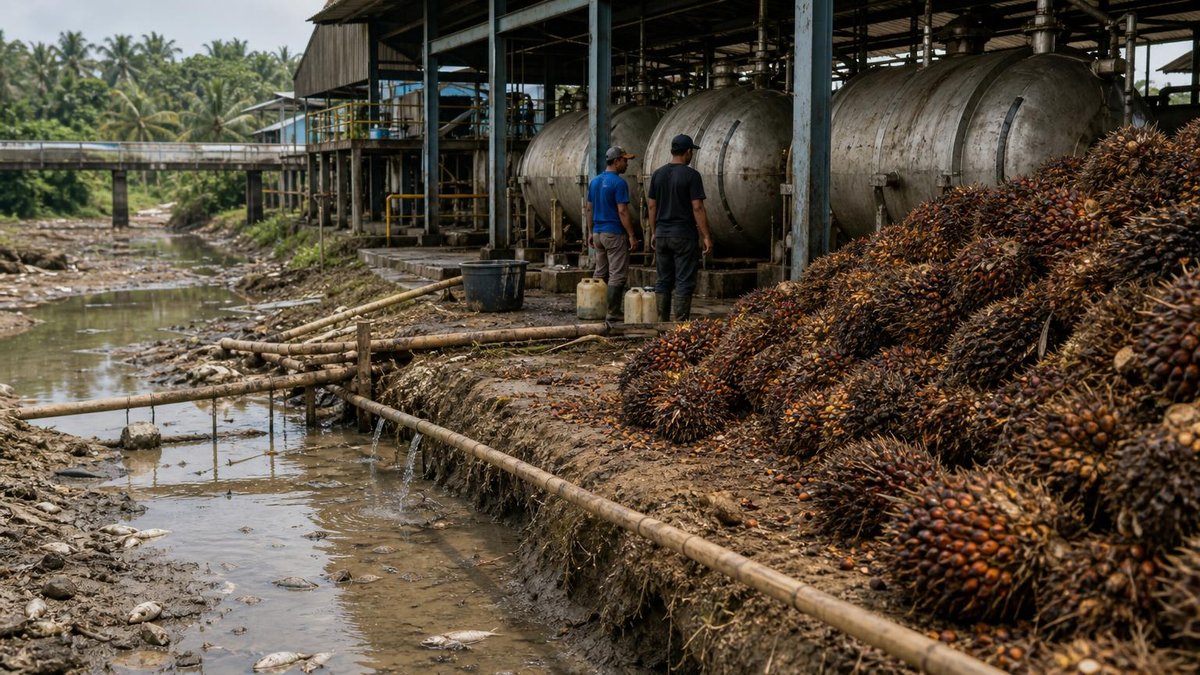
Palm oil processing is water-intensive. Fresh fruit bunches must be sterilized, stripped, and pressed within 24 hours of harvest to prevent free fatty acid buildup that ruins the oil for food use. Smallholders rely on river water for this, or they sell to mills that do. When rivers drop, the whole chain seizes.
The Kapuas, Indonesia’s longest river, saw water levels at Putussibau drop to historic lows in late 2023. Navigation, already marginal for larger vessels, became impossible for the small boats that carry harvested bunches from riverside plots to collection points. Farmers with plots farther inland faced worse: no river access at all, and no capital to drill wells or install diesel pumps that would run continuously anyway.
The economic cascade is brutal. Unprocessed bunches rot. Processed oil gets downgraded to industrial uses at lower prices. Mills idle workers. And smallholders, who produce roughly 40% of Indonesia’s palm oil according to the Indonesian Palm Oil Association (GAPKI), absorb the shock without the cash reserves or credit access that larger plantation companies enjoy.
Some farmers tried burning to clear new land, a traditional response to economic pressure that backfired catastrophically when drought-dried peat ignited. The 2023 fire season saw carbon emissions from Indonesian peat fires spike to levels not seen since the 2015 El Niño, according to Copernicus Atmosphere Monitoring Service data.
Comparing This Drought to Past El Niño Events
Indonesia has been here before, but the context has changed. The 1997-1998 El Niño was stronger in raw oceanic terms, yet palm covered far less land and the industry was less globally integrated. The 2015-2016 event saw severe fires but also a quicker price recovery. 2024 sits in a different landscape: mature palms on aging plantations, tighter sustainability certification requirements, and a global market increasingly skittish about deforestation-linked supply.
The table below compares key dimensions of recent major El Niño droughts affecting Indonesian palm production, drawing on data from Indonesia’s BMKG, the U.S. National Oceanic and Atmospheric Administration, and GAPKI production reports.
| Event | Peak Niño 3.4 Anomaly | Indonesian Palm Area (Million Ha) | Notable Impact |
|---|---|---|---|
| 1997-1998 | ~2.5°C (NOAA) | ~3.0 (GAPKI estimates) | Massive peat fires; regional haze crisis |
| 2015-2016 | ~2.6°C (NOAA) | ~11.3 (GAPKI) | 2.1 million hectares burned; $16 billion economic loss (World Bank) |
| 2023-2024 | ~2.0°C (NOAA, BMKG) | ~14.8 (GAPKI 2023) | River transport collapse; smallholder income crisis |
The expansion from 3 to nearly 15 million hectares means far more production is now exposed to drought, and far more of it depends on marginal smallholders rather than vertically integrated estates with irrigation infrastructure.
Why Sustainable Palm Oil Certification Isn’t Helping Yet
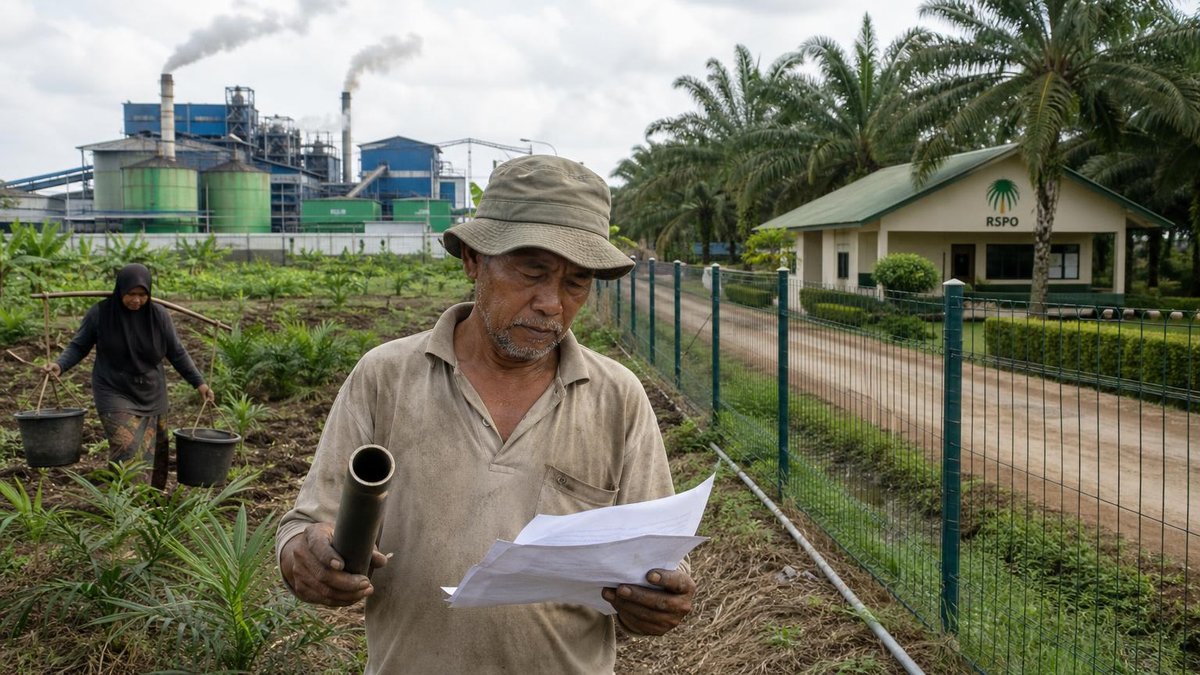
Here’s where the sustainability conversation gets uncomfortable. The Roundtable on Sustainable Palm Oil (RSPO) and Indonesian Sustainable Palm Oil (ISPO) standards include water management requirements, but these were designed with large plantations in mind. Smallholders, who must organize into groups to afford certification audits, often lack the technical capacity to implement water retention or efficient processing systems.
More critically, neither certification system currently incorporates climate adaptation metrics. A plantation can be “sustainable” by deforestation and labor standards while being completely exposed to hydrological collapse. The gap between environmental compliance and climate resilience is widening, and 2024’s drought shoved a spotlight into it.
Some researchers have started looking at whether controlled environment approaches could buffer palm production from rainfall volatility. Vertical farms and the quest for drought-resistant crops explores how soil-free cultivation and closed-loop water systems might apply to commodity agriculture, though palm’s biological constraints (it grows 10 meters tall and lives 25 years) make full indoor cultivation impractical. The lessons about water use efficiency and varietal selection, however, are increasingly relevant.
Meanwhile, Malaysia’s flooded palm oil crisis offers a perverse mirror image. While Indonesian Borneo dried out, peninsular Malaysia faced severe flooding that drowned mature palms and disrupted harvesting. The two largest palm oil producers are now experiencing opposite extremes of the same disrupted hydrological system, and neither’s infrastructure was built for it.
What Farmers Are Actually Doing
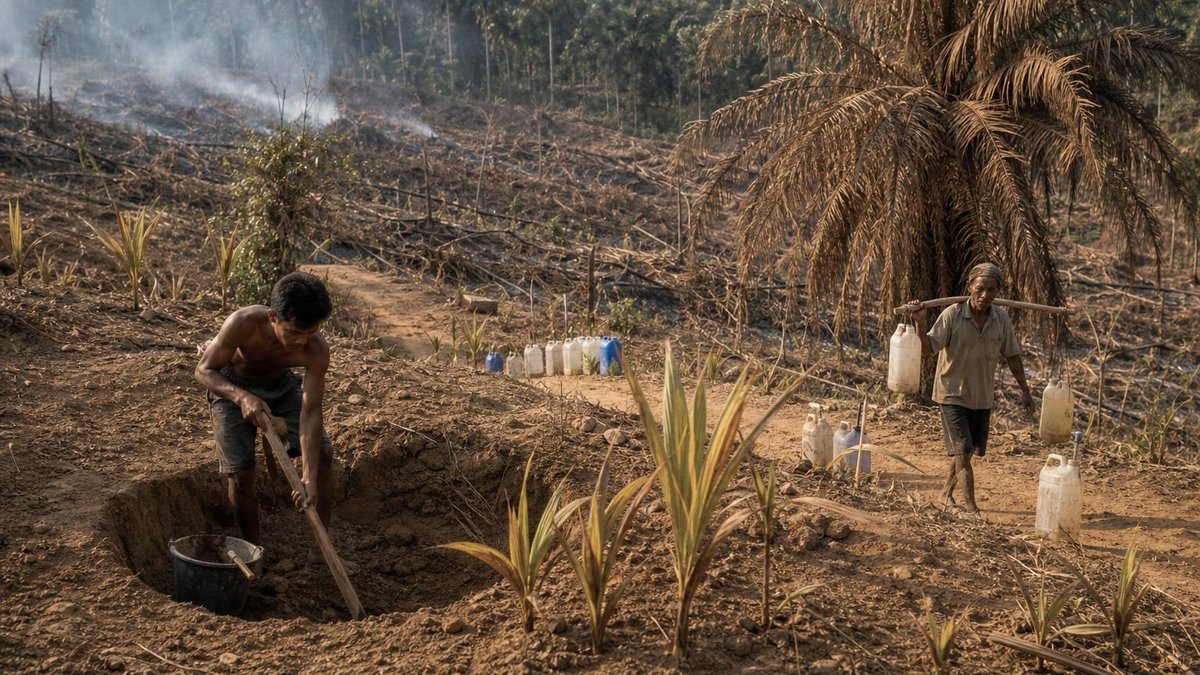
Adaptation on the ground looks less like innovation and more like desperation. Suparman and his neighbors have a short list of options, none good:
- Delay replanting of aging palms because water stress kills young seedlings faster than mature trees
- Abandon river-dependent plots and clear new land farther uphill, often on steeper, more fire-prone terrain
- Sell to middlemen at 30-40% below normal prices because they cannot transport to competitive mills
- Take informal loans at interest rates exceeding monthly compounding, trapping families in debt cycles
- Shift to mixed cropping with cassava or rubber, which tolerate drought better but earn far less per hectare
The last option is arguably the most rational long-term choice, yet it requires capital smallholders don’t have and market knowledge they can’t access. Indonesia’s agricultural extension services, never robust, have been hollowed out by budget constraints. Where agronomists do reach farmers, they’re often promoting high-input intensification that assumes reliable water, the one thing no longer guaranteed.
The Bigger Picture: Climate Change and Commodity Agriculture
Indonesia’s palm oil crisis sits at an intersection that will define tropical agriculture for decades. The crop is extraordinarily productive per hectare, which is why it replaced less efficient oilseeds globally. That productivity depends on stable tropical moisture. Climate change is destabilizing that moisture, yet the global demand for vegetable oils continues rising, driven by food, cosmetics, and increasingly biodiesel mandates in Indonesia and the European Union.
The country’s own B35 biodiesel program, which raised palm oil blending to 35% in 2023, means domestic demand now competes with export markets for constrained supply. When drought hits, the political pressure to maintain fuel subsidies squeezes food and export availability simultaneously. It’s a policy knot no one has figured out how to untie.
Some analysts argue that vertical farming as a solution to climate change challenges, while not applicable to palm itself, could relieve pressure on tropical land by producing high-value vegetables closer to consumers, reducing the economic desperation that drives smallholders toward monoculture commodity crops. The connection is indirect but real: agricultural resilience is a system property, not a crop-specific fix.
What is clear is that 2024’s drought wasn’t an anomaly to recover from. It was a preview. The IPCC’s Sixth Assessment Report projects that under moderate emissions scenarios, El Niño-like conditions will intensify and the reliable wet season that Indonesian agriculture depends upon will become increasingly erratic. The river will recede again, and again, and the farmers with no buffer will keep absorbing the shock until they can’t.
Frequently Asked Questions
Understanding El Niño and Its Impacts
What exactly is el ni and why does it affect Indonesia so severely?
El ni refers to the warm phase of the El Niño-Southern Oscillation (ENSO), a periodic warming of eastern Pacific Ocean surface waters. It affects Indonesia because the altered temperature gradient weakens the Walker Circulation, which normally brings moist air and rainfall to the western Pacific. During strong events, this moisture transport shifts eastward toward South America, leaving Indonesia and much of maritime Southeast Asia in rainfall deficit. The 2023-2024 event demonstrated this pattern with particular severity in Borneo and Sumatra.
How does ni el tiempo… ni la distancia relate to climate patterns?
This phrase, roughly “neither time nor distance,” captures something farmers articulate about drought’s unpredictability. The temporal irregularity of El Niño events (they occur every 2-7 years with no fixed cycle) and the spatial distance between Pacific temperature anomalies and Indonesian rainfall impacts create planning challenges that no amount of local knowledge fully addresses. Farmers cannot predict timing from traditional indicators as reliably as in the past.
Are the litrato ni simoun sa el filibusterismo and other character references relevant?
These search patterns reflect how online query behavior clusters unrelated topics under similar keywords. For readers arriving through such searches: José Rizal’s novel El Filibusterismo used “el” constructions that now intersect with climate terminology in search algorithms. The characters Simoun, Basilio, Isagani, and Juli inhabited a colonial Philippines facing exploitation not unlike the structural pressures on today’s Indonesian smallholders, though the direct relevance to agricultural policy is limited. The search collision itself says something about how information systems, like climate systems, produce unexpected convergences.
Practical and Policy Questions
What can smallholder palm farmers actually do to adapt?
Effective adaptation requires support structures most farmers currently lack. Priority interventions with evidence of success include:
- Community water harvesting and small-scale reservoir construction, tested in East Java with mixed results depending on geology
- Shade tree integration to reduce evapotranspiration stress, though this conflicts with standard plantation monoculture models
- Farmer cooperatives with collective bargaining power for mill access and credit, which GAPKI pilot programs have shown can reduce price exploitation
- Diversification into poultry or aquaculture where water remains available, requiring technical assistance that government extension rarely provides
How does the Indonesian palm oil crisis affect global markets?
Indonesia produces roughly 60% of global palm oil. Production shortfalls in 2023-2024 contributed to price volatility that affected food manufacturers globally, though vegetable oil markets partially compensated through soybean and sunflower oil substitution. The more persistent impact may be on sustainability commitments: companies struggling to verify deforestation-free supply from drought-stressed smallholders face compliance challenges that could reshape certification requirements.
Is there a sustainable future for palm oil production?
Sustainability in palm oil requires addressing both environmental and climate resilience dimensions simultaneously. Current certification systems handle the first poorly and the second not at all. Meaningful progress would require:
- Water stress metrics in RSPO and ISPO standards
- Climate adaptation financing directed specifically at smallholder infrastructure
- Yield improvement on existing plantations to reduce pressure for expansion into fire-prone peatlands
- Consumer country policies that reward resilience investments rather than just penalizing deforestation
None of this is technically difficult. The barriers are political and economic, which means they are harder than technical challenges and easier to ignore until the next drought arrives.
Sources
- Indonesian Agency for Meteorology, Climatology and Geophysics (BMKG), 2024. “El Niño Monitoring and Indonesian Rainfall Outlook 2023-2024.” https://www.bmkg.go.id/cuaca/el-nino-dan-la-nina.bmkg [VERIFY]
- U.S. National Oceanic and Atmospheric Administration (NOAA), 2024. “Oceanic Niño Index (ONI) and ENSO Evolution.” https://www.climate.gov/news-features/understanding-climate/climate-variability-oceanic-ni%C3%B1o-index
- Intergovernmental Panel on Climate Change (IPCC), 2021. “Climate Change 2021: The Physical Science Basis, Chapter 8: Water Cycle Changes.” https://www.ipcc.ch/report/ar6/wg1/downloads/report/IPCC_AR6_WGI_Chapter_08.pdf
- Indonesian Palm Oil Association (GAPKI), 2023. “Indonesian Palm Oil Statistics 2023.” https://gapki.id/news/26315/statistik-kelapa-sawit-indonesia-2023 [VERIFY]
- World Bank, 2016. “The Cost of Fire: An Economic Analysis of Indonesia’s 2015 Fire Crisis.” https://www.worldbank.org/en/news/feature/2016/12/05/the-cost-of-fire-an-economic-analysis-of-indonesia-2015-fire-crisis
- Copernicus Atmosphere Monitoring Service (CAMS), 2024. “Indonesian Fire Emissions 2023-2024.” https://atmosphere.copernicus.eu/copernicus-atmosphere-monitoring-service
- Roundtable on Sustainable Palm Oil (RSPO), 2024. “RSPO Principles and Criteria 2018, Version 4.” https://rspo.org/policies/standards-and-guidelines/pc/
- U.S. Energy Information Administration (EIA), 2024. “Biofuels and Indonesia’s B35 Mandate.” https://www.eia.gov/international/analysis/country/IDN
This article is for informational purposes only.

Dr. Alexander Tabibi is an entrepreneur, investor, and advocate for sustainable innovation with a deep commitment to leveraging technology for environmental and social good. As a thought leader at the intersection of business and sustainability, Dr. Tabibi brings a strategic vision to Green.org, helping guide its mission to inspire global climate awareness and actionable change.
With a background in both medicine and business, Dr. Tabibi combines analytical rigor with entrepreneurial insight.