

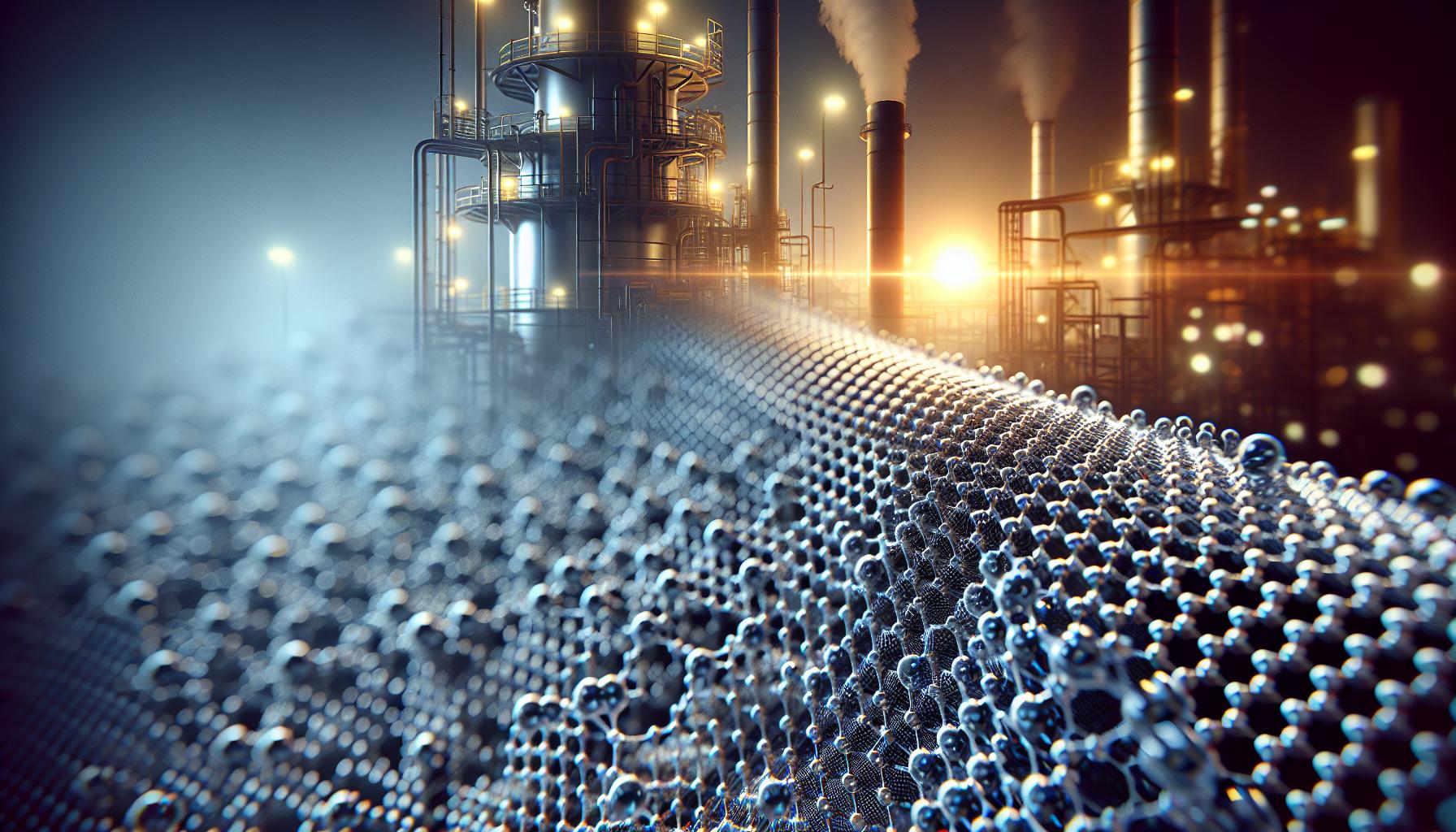
Ever heard of graphene? It’s that wonder material you might’ve spotted cruising the headlines. It’s thinner than your favorite Snapchat filter and reportedly stronger than a Hulk-level punch! But, here’s the twist–scientists are buzzing about graphene once again. This time, it’s starring as a superhero against carbon emissions.
(Being from Manchester, UK – where graphene was discovered it is one of my favorite subjects too).
Carbon Capture: What’s it All About?
Alright folks, let’s start with the basics. Carbon capture is this neat trick where we grab carbon dioxide (CO₂) right from its releasing point, usually like those big smokestacks you see at factories. This trick is crucial because too much CO₂ in the atmosphere leads to increased retention of heat in the atmosphere resulting climate change which, as you probably know already if you are reading this article, is screwing up our planet’s natural balance.
Here’s where graphene steps in. Attempts to efficiently capture carbon have been met with huge obstacles. Yet scientists are working on many different methodologies to capture carbon and a truly exciting path which could be sufficiently energy efficient to be commercially viable is with graphene membranes.
Imagine these membranes like very fine nets that are super good at catching CO₂, and they do more than fish the CO₂ out of the smoke. They make sure that it doesn’t leave the smokestacks in the first place. And now, with graphene, these nets are stronger and ready to move on those carbon emissions!
EPFL Scientists Develop Scalable Graphene Membranes for Carbon Capture
Scientists at EPFL have created a breakthrough method for producing porous graphene membranes that efficiently separate carbon dioxide (CO₂), offering a scalable, low-cost solution for carbon capture.
Traditional CO₂ capture methods are costly and energy-intensive. Graphene, an ultra-thin and strong material, has long been seen as a promising alternative, but manufacturing large, high-quality membranes has been a major hurdle.
Led by Professor Kumar Agrawal, the EPFL team developed a new technique to grow graphene on inexpensive copper foils and etch precise pores using ozone. They also pioneered a novel transfer method that prevents membrane damage, enabling the production of large, crack-free membranes up to 50 cm².
These graphene membranes demonstrated high CO₂ selectivity and permeance, operating through pressure-driven filtration without the heavy energy demands of traditional systems. The scalable process not only slashes production costs but also broadens potential applications, from industrial carbon capture to hydrogen purification and oxygen production, moving graphene membranes closer to real-world deployment.
Scaling Up: The Big Challenge
Scaling up production of graphene membranes is a challenge mainly because of three key issues:
-
Material Quality and Cost:
High-quality graphene is traditionally grown on expensive copper foils under very controlled conditions (chemical vapor deposition). Scaling this up increases material costs significantly, and any minor defects in the copper or the process can ruin large areas of graphene, leading to high waste and inefficiency. -
Fragility During Handling:
Graphene is only one atom thick, making it extremely delicate. Traditional methods involve floating the graphene on liquids to transfer it onto a support surface — a step that’s prone to introducing cracks, tears, and other defects. These tiny flaws can destroy the membrane’s ability to selectively filter gases, so scaling up without causing damage is very difficult. -
Uniform Pore Formation:
To work effectively, the graphene must have pores that are uniform in size and distribution across a large area. Creating consistent, nanoscale pores over bigger surfaces is technically complex. Small inconsistencies during pore creation can lead to performance drops, making large-scale production unreliable without advanced precision techniques.
Environmental Impact and Societal Transformations
Swooping in for a bird’s eye view, we see carbon capture as pivotal in the clean-energy saga. Policies and the public are nudging industries towards favoring green practices, and technology such as scalable graphene is their vital ally. Governments, particularly in advanced nations like the US and UK, are aiming for reduced emissions. A detailed [NASA report] describes how initiatives like carbon capture and storage become part of the rescue mission.
Now imagine, the cleaner air you breathe resulting from nimble deployment of graphene technology. These reflect wider environmental modifications, potentially dictating future legislative actions and social constructs. Incorporating innovations like these, we signal progress acknowledging our debt to the planet.
The Health Nexus: You, Me, and Our Well-being
Now, let’s circle back to where earth and health converge. Cleaner air directly relates to better health outcomes for populations everywhere. Elements like cleaner industry operations vastly improve urban air quality. This impacts a vast scale what legislators and health agencies probe daily. Studies show that each step forward diminishes respiratory ailments and overall public health risks.
Interactions between environment and wellness encapsulate a bless and curse mix. With each adept use of tech like graphene membranes, positive legacy builds upon itself ensuring inter-generational optimism. Harvard researchers detail assessments on air quality enhancements [Harvard study] and the importance these advances herald.

Dr. Alexander Tabibi is an entrepreneur, investor, and advocate for sustainable innovation with a deep commitment to leveraging technology for environmental and social good. As a thought leader at the intersection of business and sustainability, Dr. Tabibi brings a strategic vision to Green.org, helping guide its mission to inspire global climate awareness and actionable change.
With a background in both medicine and business, Dr. Tabibi combines analytical rigor with entrepreneurial insight.
2 Comments
What a wonderful site – very educational for me.
Thank you
Jeremy ( a novice)
Hi Jeremy. You are welcome. If you ever want to contribute to the site let me know. Alex