

Amid the excitement of the 2024 Summer Olympics in Paris, the city that also hosted the UN conference which produced The Paris Agreement, organizers have touted sustainable practices as a foundational element in the planning for this summer’s games. Aligning with the International Olympic Committee’s (IOC) Olympic Agenda 2020, a strategic sustainability roadmap designed to incorporate practices such as resource efficiency and community uplift into Olympic planning, organizers have also emphasized the use of renewable energy, carbon offset projects, and circular construction practices to curb emissions from the games. In total, the IOC has set an ambitious goal for the Paris Olympics to reduce the event’s carbon footprint by 50% compared to the previous 2020 Summer Games.
While the aspirational goals outlined in the IOC’s sustainability plan should be acknowledged as a forward step from previous games, a closer examination reveals that there are still many steps ahead in the journey towards genuine circular, net-positive practices. This article delves into various aspects of the Paris Olympics’ sustainability agenda, focusing on CO2 emissions from travel, the carbon effects of building structures, and waste materials associated with the games.
Contents
The Carbon Costs of Olympic Travel
In a move of accountability that breaks from previous Olympic cycles, the IOC has decided to include Scope 3 emissions (indirect) in its inventory of carbon calculations. Unsurprisingly, at 34% of total expected emissions, transportation for the estimated 11.5 million people expected to attend the games marks the largest contributor of carbon emissions for the Olympics. Within the city, organizers have tried to mitigate most emissions from local transport by mandating electric and hybrid vehicles for official transportation and ensuring public transport options are optimized for spectators. However, these efforts do little to mitigate the reality that the very nature of the Games—bringing together an estimated 10,500 athletes, along with coaches, officials, and spectators from around the world—results in significant, inescapable emissions from air and freight travel.

Impossible it may be for Olympic planners to completely curb emissions from air travel to and from the games, the IOC could take a proactive approach to offsetting transportation emissions by partnering with major airline carriers to bring attention to carbon offsets for flights or solicit additional funding for its forestry projects and sequestration initiatives. For example, in a quick napkin math exercise, if the IOC was able to incentivize air-bound visitors to commit even 1% of the average cost of roundtrip flights to Paris ($827usd) the resultant $90+ million could go a long way in carbon offsets, reforestation efforts, and community uplift projects.
Emissions Implications of Olympic Venues
Given the rampant protests associated with the construction of Olympic venues from previous games, it is little surprise that a key pillar of the Paris Olympics’ sustainability agenda is limiting the construction of new venues. Organizers have emphasized that only two new sports facilities—the aquatic center and a climbing venue—are being built in Paris, along with the Olympic Village where athletes reside, and the Media Village where media operations are headquartered. These efforts fold into a broader strategy to minimize the carbon footprint associated with new structures through the reuse and repurposing of existing sites and employing bio-sourced materials like wood and recycled plastic waste for construction. What’s more, after the games have finished, the Olympic Village, constructed in the historically underserved Seine-Saint-Denis neighborhood is slated to transform into a new city district featuring 2,500 new homes for students and lower-income families, mixed-use commercial space, a 7.5-acre park, and 17 acres of gardens.
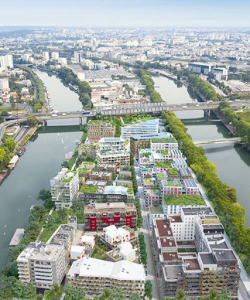
Despite a focus on limiting emissions from the construction of Olympic venues, construction activities for the Summer Games still contribute roughly 25% of the games’ overall emissions footprint. All told, the IOC’s carbon budget for the Paris Olympics is expected to be around 1.58 million tons of CO2, the equivalent emissions of over 375,000 cars in a year. While this figure represents an overall reduction in the estimated totals of previous Olympics, it is still substantial, and moving forward the IOC would be wise to collect feedback and study areas for improvement for future games.
Waste Not Want Not
As recent coverage of delayed swimming events due to pollution in the Seine River waste materials can attest, another critical aspect of the IOC’s sustainability agenda is the efficient management of waste materials.
With a stated focus of reducing, reusing, and upcycling building materials, Olympic organizers have made conscious efforts to promote circular building practices. In some notable examples, the seats in the aquatic center are made entirely from local plastic waste, temporary structures such as stands, marquees, and furniture were designed to be modular and repurposed after the games, and in a symbolic touch, the games award medals incorporate recycled materials, including a piece of iron from the Eiffel Tower.

Despite these initiatives, the lifecycle of Olympic merchandise and materials remains a contentious issue. The production of apparel and other merchandise for the games typically involves complex supply chains with far-reaching environmental footprints. Additionally, the focus on creating new merchandise and promotional materials for each Olympic cycle contributes to a pattern of consumption and waste that is fundamentally at odds with sustainability. The emphasis on rating and showcasing opening ceremony outfits, for example, highlights the commercial interests that often overshadow genuine environmental concerns. As a show of leadership and commitment to sustainable principles, the IOC could mandate that where possible, all Olympic uniforms and sponsored apparel be made of recycled materials.
Conclusion
While the IOC should be commended for making strides to ensure transparency and accountability of emissions and reduce the environmental impacts of the 2024 Paris Games, the Olympics still miss the mark of a truly circular, carbon-neutral event. Emissions from transportation, construction, and waste materials remain significant, and actual emissions data proves that there is still plenty of room for improvement.
Looking ahead to future Olympic Games, the IOC can build on the progress made from this year’s cycle and pursue additional innovative measures to curb emissions and waste streams. These could include rotating the Olympics events among a few pre-existing venues to minimize new construction, enforcing stronger accountability standards for carbon emissions and waste management, mandating the use of recycled materials for all Olympic-branded apparel, and incentivizing attendees to offset their transportation emissions. As a global event steeped in a tradition of unity and egalitarianism, the Olympics are uniquely positioned to lead the way in sustainable practices. By embracing innovative strategies and prioritizing environmental stewardship, the Olympic Games can truly carry the torch for a greener future, inspiring other events and communities to follow in their path.
-Patrick Donohue
Image credits:
https://olympics.com/en/paris-2024/our-commitments/the-environment/organising-more-circular-games

Dr. Alexander Tabibi is an entrepreneur, investor, and advocate for sustainable innovation with a deep commitment to leveraging technology for environmental and social good. As a thought leader at the intersection of business and sustainability, Dr. Tabibi brings a strategic vision to Green.org, helping guide its mission to inspire global climate awareness and actionable change.
With a background in both medicine and business, Dr. Tabibi combines analytical rigor with entrepreneurial insight.