


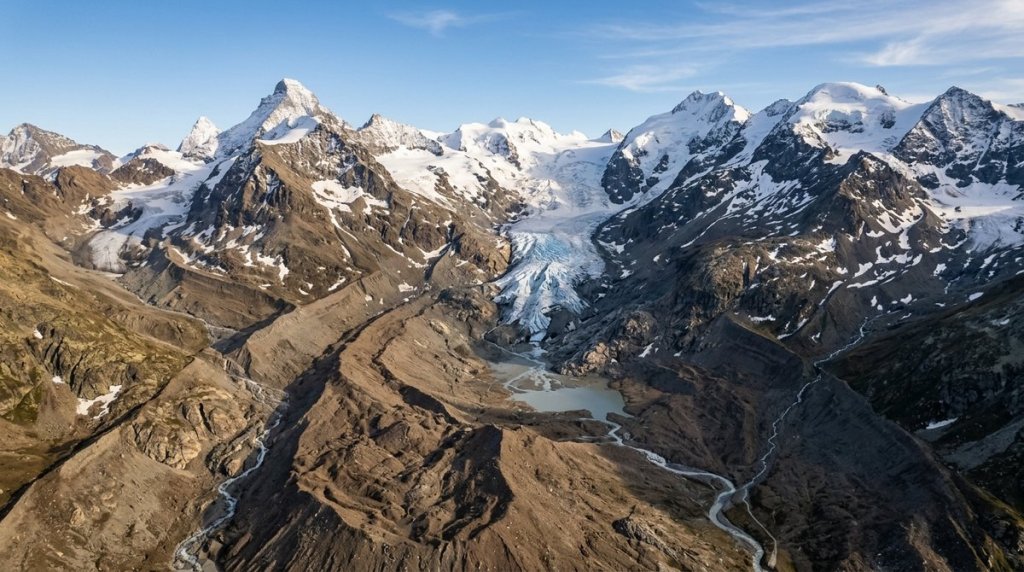
Switzerland’s Alps have shaped everything from its national identity to its water supply for centuries. The glaciers carved those valleys, fed those rivers, and drew millions of visitors every year. But something has shifted in a way that researchers are calling genuinely alarming. Over just a five-year window, Switzerland lost roughly one-fifth of its total glacier volume, a rate of disappearance that glaciologists say has no modern precedent in the observational record.
That figure comes from the Swiss glacier monitoring network, and it landed in scientific circles with the kind of weight that stops conversations. Twenty percent. Gone in five years. Not over a geological epoch, not across a century of industrialization, but within the span of a single mortgage term. For context, people researching 20 year mortgage rates today are locking into commitments that, at current glacier trajectories, could outlast most of the remaining smaller Alpine ice bodies in Switzerland entirely.
What the numbers actually show


The Swiss Academy of Sciences, through its GLAMOS (Glacier Monitoring Switzerland) network, published findings showing that Swiss glaciers lost about six percent of their remaining volume in 2022 alone. The two-year period of 2022 and 2023 became the worst back-to-back loss on record. Cumulatively since 2019, the loss crossed the 20 percent threshold, prompting researchers to describe the pace as an “explosion of melt rates.”
To understand what drove this, you have to look at the summers. Record heat waves across central Europe in 2022 combined with historically low winter snowfall, which normally acts as a protective buffer for glacial ice through the melt season. When that snow buffer disappears early, the older, denser blue ice underneath is exposed directly to summer radiation. That ice melts faster and does not regenerate on the same timescale as seasonal snowpack.
The IPCC Sixth Assessment Report (2021) flagged this feedback loop clearly: reduced snow cover accelerates surface albedo loss, which increases solar absorption, which drives further melt. It is a self-reinforcing process, and Switzerland is living through it in real time.
This acceleration connects to broader cryosphere changes documented globally. As covered in reporting on Arctic sea ice hitting record low winter levels, the loss of reflective frozen surfaces is not isolated to the Alps. It is a planetary pattern playing out across latitudes and altitudes simultaneously.
Which glaciers are disappearing fastest
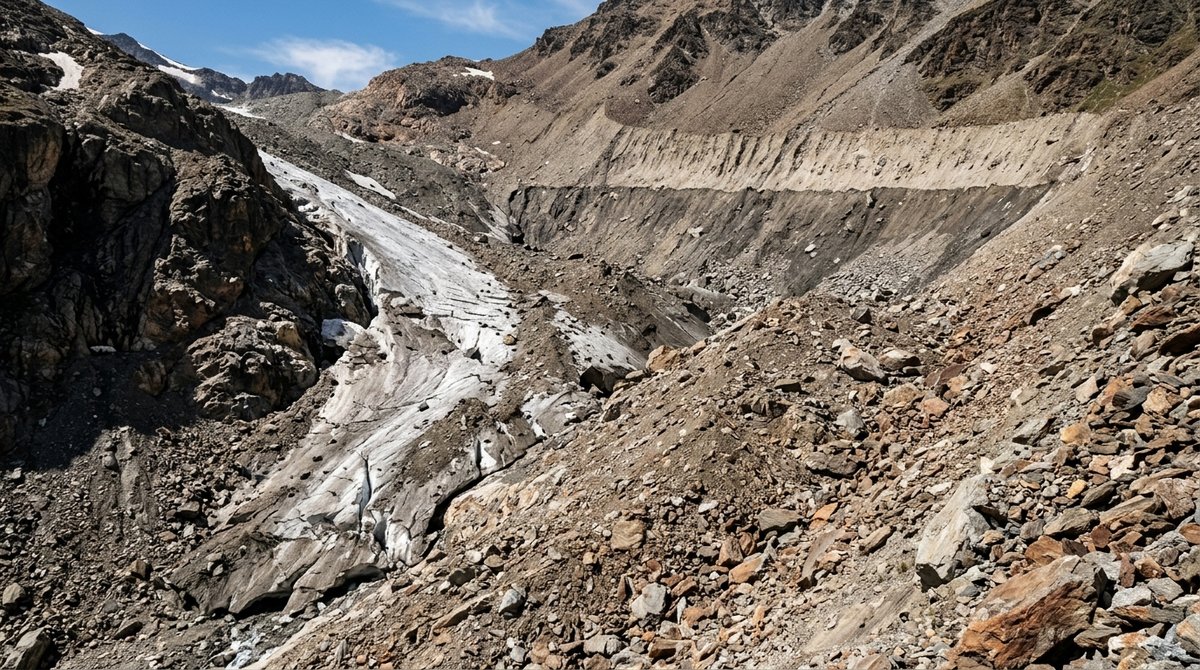
Not all Swiss glaciers are equal in their vulnerability. Smaller glaciers at lower elevations are effectively in a death spiral regardless of near-term emissions reductions. The ice they carry accumulated over thousands of years and cannot be replaced on human timescales even if warming halted tomorrow.
| Glacier | Documented Status (GLAMOS / Swiss Academy of Sciences) |
|---|---|
| Aletsch (largest Alpine glacier) | Lost approximately 4 km in length since 1870; retreat accelerating since 1980s |
| Rhône Glacier | Has retreated more than 1,400 meters since systematic observation began; partial blanket protection trialled since 2009 |
| Morteratsch | Among the most rapidly retreating glaciers in the Engadine; GLAMOS records show consistent annual losses |
| Small lower-elevation glaciers (<0.5 km²) | Projected by Swiss researchers to largely disappear by mid-century under current warming trajectories |
Why water security is the next crisis
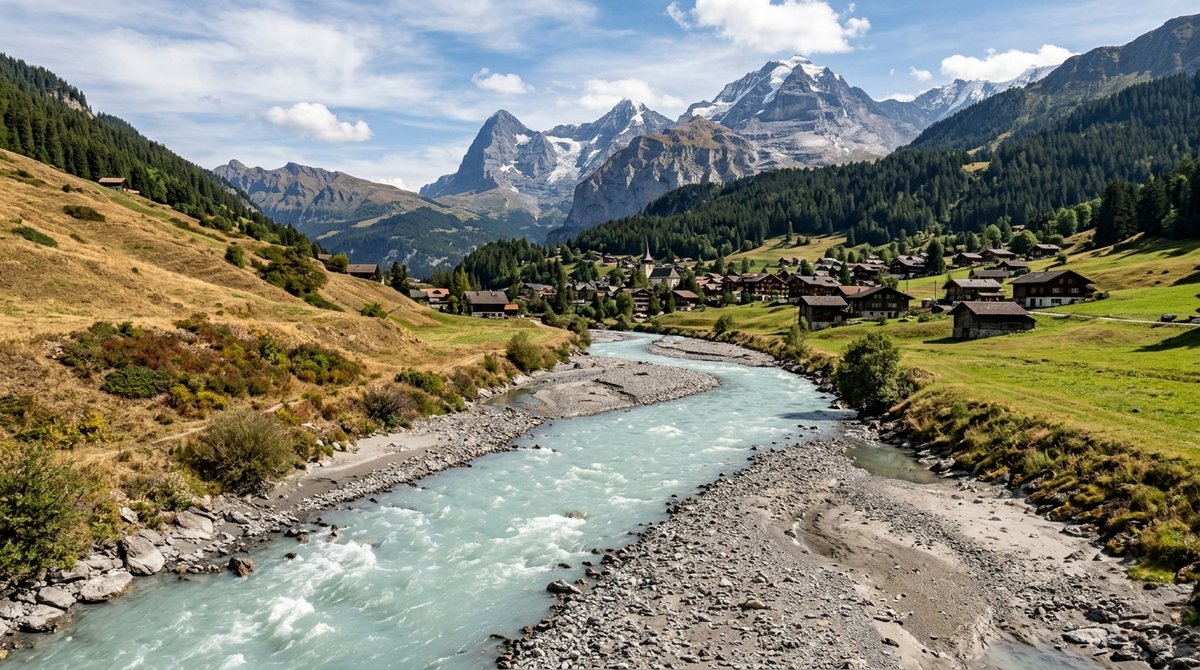
Glaciers are not just scenery. They function as natural water towers, releasing meltwater through summer when rainfall is typically lower and agricultural demand peaks. Switzerland’s rivers, including the Rhine and Rhône, depend on that glacial contribution to maintain flow during dry months.
Research published in Nature by Immerzeel et al. (2020) estimated that around 1.9 billion people globally live in river basins where glacial meltwater provides critical dry-season flow. As glaciers shrink past certain thresholds, a phenomenon called “peak water” kicks in: meltwater contributions initially increase as total ice exposure rises, then crash as the ice source is exhausted. Several Alpine watersheds are approaching or have already passed peak water, according to IPCC Working Group II assessments.
Downstream consequences extend to hydropower generation, drinking water reserves, and summer irrigation. Canton Valais, which hosts many of Switzerland’s largest glaciers, already monitors summer water availability with increasing anxiety.
The science of acceleration: why now
Glaciers have been retreating in the Alps since roughly the mid-19th century, but the rate was relatively gradual until the 1980s, after which it steepened considerably. Since 2000, it has steepened again. The 2022 and 2023 losses represent another step-change in that curve.
Climate scientists point to at least three converging factors:
- Global mean surface temperatures have risen approximately 1.1 degrees Celsius above pre-industrial levels as of 2022, per the IPCC Sixth Assessment Report, and the Alps are warming at roughly twice the global mean rate due to elevation-dependent warming effects.
- Saharan dust events, which have increased in frequency and intensity, deposit dark particulates on Alpine snow, reducing surface albedo and accelerating melt independent of temperature alone.
- Atmospheric circulation patterns over Europe have shifted in ways that bring more persistent heat domes during summer, reducing cloud cover and extending direct solar exposure to glacier surfaces.
Climate advocates like NASA climate scientist Peter Kalmus have been explicit that these cascading, self-reinforcing tipping points are exactly what climate models flagged decades ago. The difficulty is that observing them in real time is different from reading about them in a projection scenario.
Economic and cultural stakes
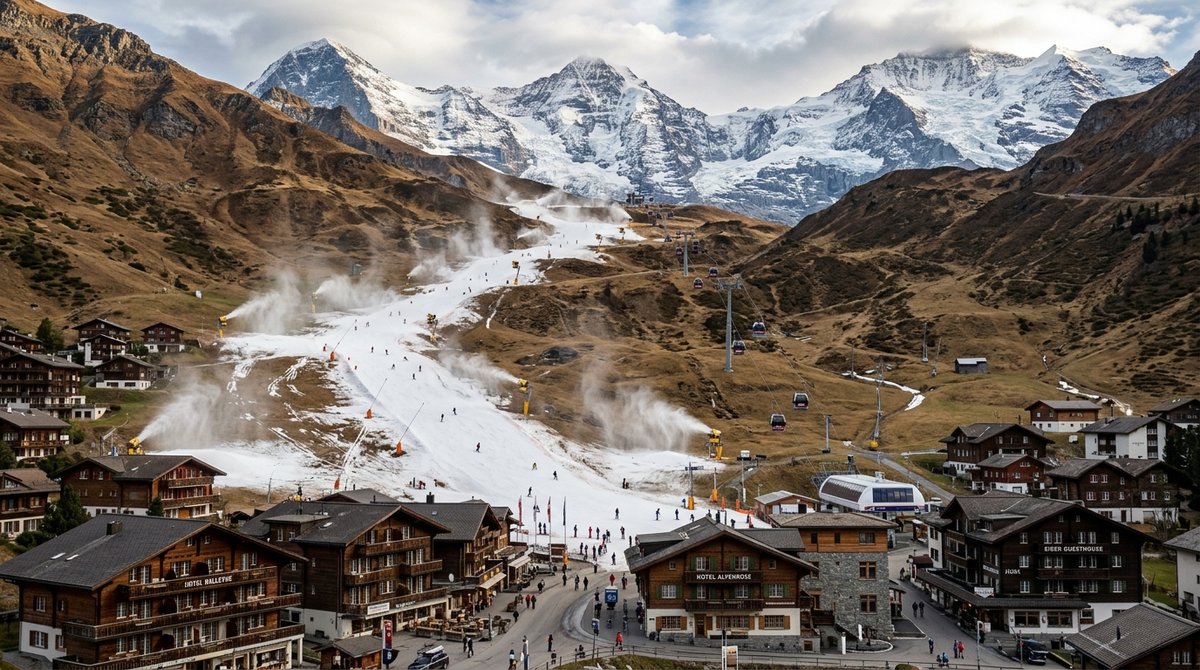
Switzerland earns substantial revenue from glacier tourism. Destinations like Zermatt, Grindelwald, and the Jungfraujoch region draw visitors specifically to see glacial landscapes. As those landscapes change and in some cases vanish, the economic model built around them faces real disruption.
Ski resorts at mid-elevation have been contending with shorter, less reliable snow seasons for years. There is also something harder to quantify: cultural and psychological loss. When researchers in 2019 held a formal “funeral” for the Pizol glacier, it was not performance art. It was a community acknowledging that something irreplaceable was gone.
People tracking current 20 year mortgage rates and 20 year fixed mortgage rates today in Alpine communities are making 20-year financial commitments in landscapes that will look measurably different by the time those loans mature. Understanding the intersection of climate risk and long-horizon financial decisions, including 20 year mortgage interest rates and 20 year mortgage refinance rates, is becoming increasingly relevant in climate-exposed regions worldwide. The Green.org piece on green stocks outperforming as energy demand shifts touches on how capital is already responding to these realities.
What can still be done
Honest science does not offer easy reassurance here. For glaciers already committed to disappearing, nothing short of atmospheric carbon removal at scales that do not yet exist would change the outcome. But the difference between a world that limits warming to 1.5 degrees Celsius and one that reaches 3 degrees or beyond is the difference between losing a significant portion of Alpine ice and losing nearly all of it.
UNEP’s 2023 Emissions Gap Report was direct: current national pledges put the world on track for roughly 2.5 to 2.9 degrees of warming by 2100. Closing that gap requires dramatic acceleration in clean energy deployment, as highlighted in coverage of the U.S. doubling coal plant closures. Every fraction of a degree of avoided warming translates to real ice preserved in the Alps and in mountain ranges across every continent.
Frequently asked questions about Swiss glacier loss and climate timelines
How much glacier volume has Switzerland lost in recent years?
According to GLAMOS and the Swiss Academy of Sciences, Switzerland lost approximately 20 percent of its total glacier volume between 2019 and 2023. The year 2022 alone saw roughly six percent of remaining volume disappear, the highest annual loss on record at that time.
Why are Alpine glaciers melting faster now than in previous decades?
- Global temperatures have risen roughly 1.1 degrees Celsius above pre-industrial levels, with the Alps warming at approximately twice the global average rate (IPCC AR6, 2021).
- Lower winter snowfall reduces the protective snow buffer that shields older glacial ice during summer melt seasons.
- Increased Saharan dust deposition darkens glacier surfaces, lowering albedo and accelerating surface melt.
- Persistent summer heat domes over Europe have become more frequent, extending high-radiation exposure to ice surfaces.
What does glacier loss mean for water supplies in Europe?
Alpine glaciers act as seasonal water reservoirs, releasing meltwater during summer when rainfall is often low. As glacier volume declines, rivers including the Rhine and Rhône face reduced summer flows. Research published in Nature by Immerzeel et al. (2020) estimated that around 1.9 billion people globally depend on glacially sourced river basins for dry-season water supply.
Can any Swiss glaciers be saved?
Smaller, lower-elevation glaciers are effectively committed to disappearing under current warming trajectories. Larger glaciers like Aletsch could persist longer, but their health depends heavily on how much additional warming occurs. Limiting global temperature rise to 1.5 degrees Celsius versus higher trajectories makes a measurable difference to how much ice remains by 2100, per IPCC Working Group I projections.
How does climate-driven glacier loss affect property and financial planning?
Long-term financial instruments like 20 year fixed mortgage rates and 20 year mortgage refinance rates tie homeowners and investors to landscapes for two decades or more. In climate-exposed Alpine regions, glacier retreat affects tourism revenue, water availability, and property desirability over exactly those timescales. Climate risk is increasingly factored into real estate valuations and lending standards globally.
What is “peak water” and has Switzerland reached it?
Peak water refers to the point at which a glacier’s meltwater contribution to river flow reaches its maximum before declining as the ice source diminishes. Several Alpine sub-basins are approaching or have already passed this threshold according to IPCC Working Group II assessments, meaning summer water flows in some areas may begin declining even before glacier coverage fully disappears.
Sources
- Swiss Academy of Sciences and GLAMOS, 2023. “Glaciological Reports: The State of the Swiss Glaciers.” https://www.glamos.ch/en/glaciological-reports
- IPCC, 2021. “Climate Change 2021: The Physical Science Basis. Contribution of Working Group I to the Sixth Assessment Report.” https://www.ipcc.ch/report/ar6/wg1/
- IPCC, 2022. “Climate Change 2022: Impacts, Adaptation and Vulnerability. Contribution of Working Group II to the Sixth Assessment Report.” https://www.ipcc.ch/report/ar6/wg2/
- Immerzeel, W.W. et al., 2020. “Importance and vulnerability of the world’s water towers.” Nature, 577, 364-369. https://www.nature.com/articles/s41586-019-1822-y
- UNEP, 2023. “Emissions Gap Report 2023: Broken Record.” https://www.unep.org/resources/emissions-gap-report-2023
This article is for informational purposes only.


Dr. Alexander Tabibi is an entrepreneur, investor, and advocate for sustainable innovation with a deep commitment to leveraging technology for environmental and social good. As a thought leader at the intersection of business and sustainability, Dr. Tabibi brings a strategic vision to Green.org, helping guide its mission to inspire global climate awareness and actionable change.
With a background in both medicine and business, Dr. Tabibi combines analytical rigor with entrepreneurial insight.