

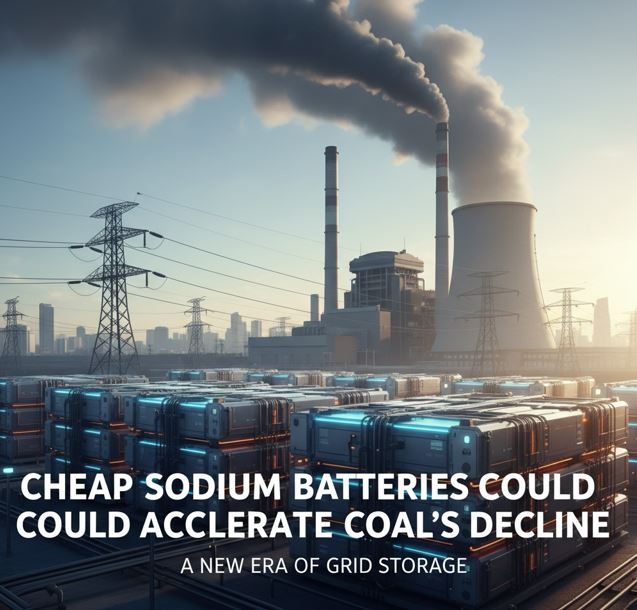

For decades, coal has been at the heart of industrial power generation, but the emergence of low-cost, high-performance sodium batteries is setting the stage for a massive shift in global energy economics — one that could push coal’s long-standing dominance closer to extinction.
As costs plunge and new projects scale up, sodium-based energy storage is emerging as a game-changing technology that complements wind and solar power, while accelerating the decline of fossil fuels. To ensure a sustainable transition, understanding the role of government policy can be pivotal in shaping recycling habits and energy policies.
Contents
- 1 The End of Coal’s Comeback
- 2 Why Sodium Is Stepping Into the Spotlight
- 3 Technical Advantages Over Lithium Systems
- 4 A Growing Field of Innovators
- 5 The Economic Pressure on Coal
- 6 Global Momentum: China, Australia, and Beyond
- 7 Renewables Paired with Sodium Storage: A Tipping Point
- 8 A New Energy Era on the Horizon
The End of Coal’s Comeback
In recent years, there have unfortunately been attempts to revive coal power plants across the United States and abroad (especially now with the emergence of power hungry artificial intelligence). Energy price spikes and grid reliability concerns have, at times, given coal a temporary lifeline. Yet those efforts appear short-lived. According to CleanTechnica’s Tina Casey, the so-called “national energy emergency” that once promised new life for aging coal stations is already fading. The reason? An accelerating clean energy transition driven by cheaper, more versatile battery technology — particularly sodium-based storage systems. This development parallels innovative strategies seen in the intersection of art and recycling which raise awareness and drive change.

Why Sodium Is Stepping Into the Spotlight
Sodium batteries have long been viewed as lithium-ion’s less glamorous cousin — abundant and affordable but less energy-dense. Recent breakthroughs, however, are reshaping that perception. Sodium is one of Earth’s most plentiful elements, available nearly everywhere and easy to process. That abundance alone makes it a strong candidate for large-scale energy storage, especially as lithium supplies tighten and costs fluctuate.
The world’s largest battery manufacturer, CATL, has reported that sodium battery production costs are roughly 30% lower than comparable lithium iron phosphate (LFP) batteries. Even more striking, CATL projects sodium battery costs could drop to around $19 per kilowatt-hour within just a few years — down from roughly $55–$60 for lithium phosphate today. That’s more than a marginal gain; it’s a transformational shift in cost efficiency. This advancement in sodium batteries is as significant that have impacted waste reduction efforts globally.
Technical Advantages Over Lithium Systems
Sodium-based batteries are not just cheaper — they’re built to last longer and perform better in certain environments. In cold conditions, where lithium-ion cells often lose efficiency, sodium cells maintain strong performance. They also exhibit lower degradation over time, extending operational lifespans and reducing the need for costly system augmentations.
Peak Energy projects that its sodium systems will deliver around 30% longer lifespans and significantly lower maintenance costs compared to lithium-ion alternatives. Their passive cooling system reduces auxiliary power needs by up to 97%, meaning more stored energy goes directly into the grid instead of running temperature control systems.
These advantages make sodium batteries particularly suited for large-scale grid storage — the segment that will play a pivotal role in replacing coal and natural gas plants as grid stabilizers. In this arena, cost, reliability, and scalability matter more than having the highest energy density.
A Growing Field of Innovators
The wave of sodium innovation has already begun. While some early players have stumbled — such as Natron Energy’s closure of its North Carolina sodium battery plant — a new generation of companies is quickly advancing the field. Among them is the U.S.-based startup Peak Energy, which has swiftly become one of the most closely watched entrants in the sodium storage industry.
Launched in 2022 by veterans from Tesla, Apple, and leading energy storage firm Powin, Peak Energy has built a vertically integrated business model centered on efficiency and cost reduction. Its proprietary passive cooling design eliminates the need for complex fan systems required by lithium-ion batteries. This not only cuts costs but also improves safety and reliability.
Peak Energy’s confidence has attracted major investors, including Zora Innovation (a branch of Teasec), Eclipse, and TDK Ventures. In mid-2024, the company secured $55 million in Series A funding to scale operations and prepare for its first gigafactory, slated to open in 2027. The same year, Peak will deliver a 720-megawatt sodium system to renewable power developer Jupiter Power — with the potential to expand that deployment by another 4,000 megawatts through 2030. The total project value is estimated at over $500 million.
The Economic Pressure on Coal
Coal’s decline in the U.S. has been steady for over a decade, but the arrival of cheap, scalable energy storage could dramatically accelerate that trend. As Tina Casey notes, falling costs for both renewable generation and energy storage make it increasingly difficult for coal power plants to compete. The economics simply no longer favor a fuel source that’s expensive, polluting, and politically unpopular.
Even with federal subsidies aimed at prolonging coal operations, including loans and grants for retrofitting old facilities, the market signals are clear. In 2024 alone, the U.S. Federal Energy Regulatory Commission reported plans for over 8 gigawatts of coal plant retirements. Major closures include Intermountain Power in Utah (1.8 GW), J.H. Campbell in Michigan (1.33 GW), and Brandon Shores in Maryland (1.27 GW). While some retirement timelines have been delayed, the writing on the wall is unmistakable.
Global Momentum: China, Australia, and Beyond
While the U.S. market is gaining traction, China and Australia are moving even faster. China’s electricity demand has grown roughly 16% in the past year, yet its emissions have declined thanks to rapid renewable deployment paired with large-scale energy storage. In these markets, sodium batteries are already finding commercial applications in both grid storage and electric mobility.
Renewables Paired with Sodium Storage: A Tipping Point
As renewable deployment continues, intermittent generation remains a central challenge. Wind and solar are abundant but variable, requiring reliable storage to maintain consistent grid supply. Sodium battery systems, with their long lifespans and low costs, could fill this gap far more economically than lithium-ion ever could. This capability turns renewables into true 24/7 power sources — the kind that make coal redundant.
A New Energy Era on the Horizon
Coal’s era is ending not with a political decree, but through market forces shaped by science, innovation, and economics. As sodium battery production scales, renewable projects will become even more cost-effective — enabling utilities to retire coal plants permanently without risking reliability. The shift may not happen overnight, but each new sodium contract, each gigafactory announcement, and each decline in battery prices moves that horizon closer.
By the late 2020s, when Peak Energy’s first gigafactory comes online and global sodium production ramps up, the term “clean energy baseload” may no longer sound like an oxymoron. The sun will still rise, the wind will still blow, and with sodium storage powering the transition, coal will likely fade into history — a relic of industrial progress overtaken by technological evolution.
This article is for informational purposes only.
Reference:



Dr. Alexander Tabibi is an entrepreneur, investor, and advocate for sustainable innovation with a deep commitment to leveraging technology for environmental and social good. As a thought leader at the intersection of business and sustainability, Dr. Tabibi brings a strategic vision to Green.org, helping guide its mission to inspire global climate awareness and actionable change.
With a background in both medicine and business, Dr. Tabibi combines analytical rigor with entrepreneurial insight.